



Driveway Paint: What to Use on Concrete and Asphalt, and How to Prevent Peeling

Key Takeaway
Driveway paint is not a single product but a coating system matched to your surface: exterior, vehicle-traffic-rated acrylic or epoxy-modified acrylic for concrete, and an asphalt-specific acrylic or seal-coat for asphalt. Proper prep, including oil removal, crack repair, and a moisture check, determines whether the finish lasts five or more years or peels within a season. A penetrating stain or sealer is often the lower-maintenance alternative to opaque paint.
Yes, you can paint a driveway. But there's no single product called "driveway paint" that works everywhere. You need an exterior, vehicle-traffic-rated coating made specifically for either concrete or asphalt, and the prep plus the product choice decide whether it holds up or peels in a season. If you're a homeowner who wants a cleaner, fresher look without ripping out and replacing the slab, this guide gives you a decision framework rather than a list of products to buy. The one idea everything here depends on: driveway paint is a coating system, not just a can of paint. The same logic applies to related flatwork like patios, walkways, and pool decks, where tires and foot traffic put real stress on any finish.
First, Is Your Driveway Concrete or Asphalt?
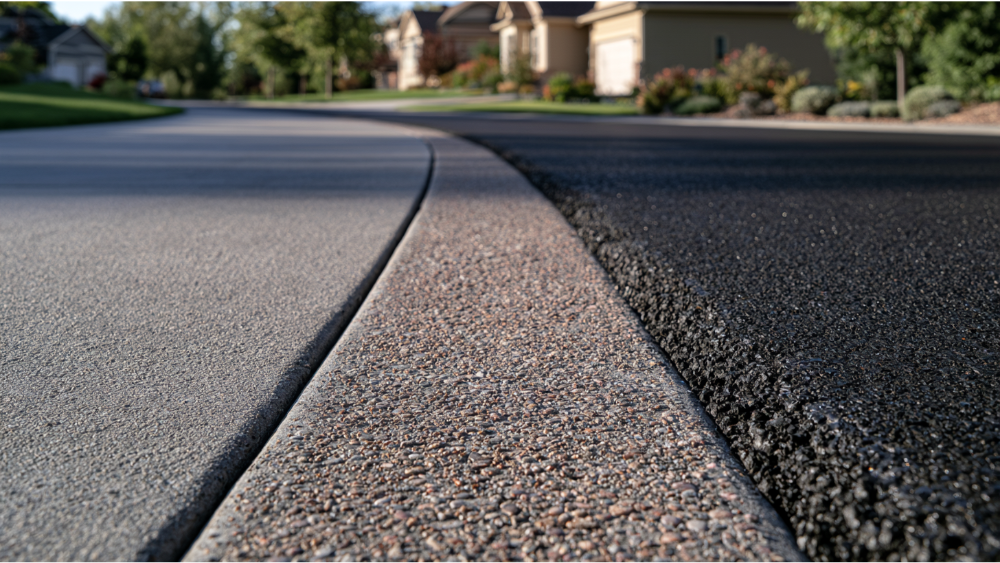
This is the first decision because the products are not interchangeable. Coatings are formulated to bond to one surface or the other, and using the wrong one is the fastest route to failure.
Concrete is rigid, gray, and usually jointed with control lines cut into it. Asphalt is flexible, black, and poured as a continuous surface that softens in heat. Those differences matter: some asphalt-specific acrylic coatings state plainly on their data sheets that they're not recommended for concrete. And the old myth that asphalt "can never be painted" is too broad. The accurate rule is to use an asphalt-compatible coating or seal-coat system, not a concrete product and not standard paint. If your driveway is set with pavers rather than a poured slab, the approach changes again, since the joints and individual units behave differently than a continuous concrete surface. The same goes for a brick drive, where the units and the mortar lines react separately to any finish you apply.
Should You Paint, Stain, or Seal Your Driveway?
Here's the honest tradeoff. Opaque paint gives the fullest color change, but it adds a surface film that can peel, chip, and wear in the tire lanes. A penetrating stain colors porous concrete without creating that peel-prone film. A penetrating sealer mainly protects while keeping the natural concrete look, and it's often reapplied every two to three years for ongoing protection. Once a concrete driveway is sealed, water and oil sit on top rather than soaking in, which makes cleaning easier and extends the life of whatever you put down.
OptionAppearanceBest forMaintenance tolerancePaint / opaque coatingFull, solid colorComplete color change on sound concreteHigher: touch-ups, peel riskPenetrating stainNatural variation, tintedColor without a surface filmLowerPenetrating sealerNatural concreteProtection, no color changeLow, reapply periodicallyResin coatingSolid, often glossyAbrasion/chemical resistance (if exterior-rated)ModerateAsphalt coatFresh blackRefreshing/protecting asphaltModerate
High-gloss colored concrete sealers exist if you want some color with less film. Many of these let you tint the sealer, so you get a hint of color without the thick film that an opaque coating builds. Picking from a color palette is the enjoyable part, but it comes after the surface questions are settled. The point we'd make to any homeowner: the right answer is sometimes stain or sealer, not paint.
What Water Based Concrete Paints and Coatings Should You Use?
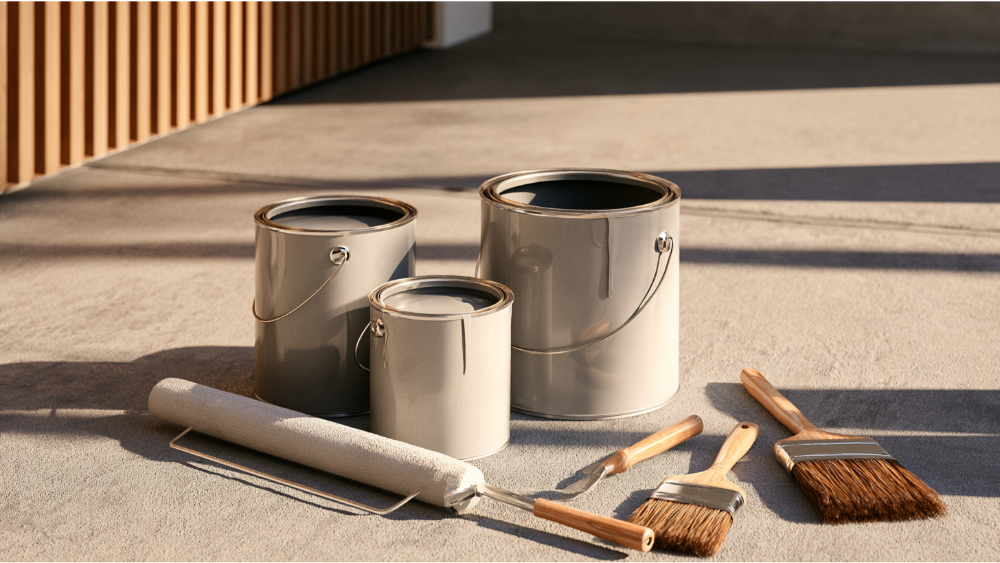
For concrete, exterior acrylic or epoxy-modified acrylic coatings handle moderate vehicle traffic well, and water based options are widely available. Water based acrylic concrete paints clean up easily and give off less odor during application, which is part of why they've become the easy part of most residential driveway projects. They also tend to be the economical choice for a large slab compared with full two-component systems. Hybrid acrylic coatings blend durability with easier application. Two-component resin systems can offer more abrasion and chemical resistance, but only use them when the full system is rated for exterior UV, moisture, and vehicle traffic. Low-VOC concrete paint options exist if emissions are a concern.
For asphalt, use an asphalt-specific acrylic coating or a seal-coat system built for flexible pavement.
What to avoid, because none of these hold up under tires:
- Interior or standard wall paint
- Vertical masonry paint
- Unqualified porch paint not rated for vehicle traffic
- Interior-only epoxy
- Plain acrylic latex
If the label doesn't say exterior and vehicle-traffic-rated for your surface, it's the wrong product. The pigments in a purpose-built concrete coating are chosen to hold color outdoors, which is why a bargain can of the wrong paint fades fast. Manufacturers such as Sherwin Williams publish detailed data sheets for their concrete systems, and reading those specs is time well spent before you buy.
Is Epoxy Really the Best Choice for a Driveway?
Not automatically. Epoxy bonds chemically to concrete and resists chemicals, which is why it's popular for garage floors. But conventional epoxy can chalk or yellow under sunlight unless it's a UV resistant formulation or it carries an exterior-rated topcoat. Polyaspartic coatings offer higher UV resistance if you want a resin system outdoors, and they're common on garage floor projects where a durable, glossy floor is the goal. The honest framing: every component must be rated for exterior UV, moisture, vehicle traffic, and your driveway's temperature range. "Epoxy is best" skips the part that actually determines whether it lasts outside.
When Painting a Driveway Is a Bad Idea
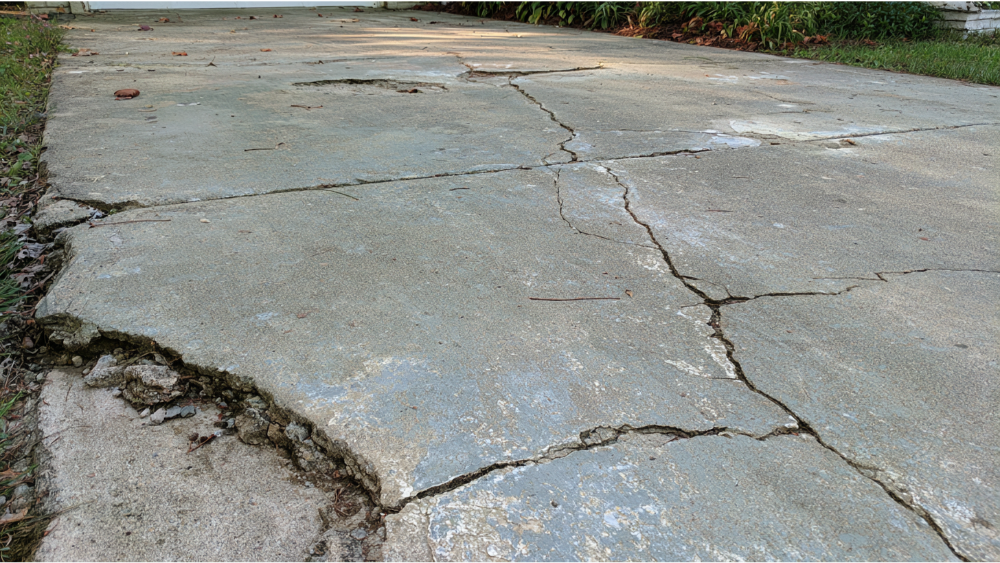
Coating a failing surface wastes money. Repairs come before cosmetics, always. Hold off on paint if you see any of these:
- Structural cracks or active movement
- Settlement or uneven sinking
- Spalling (flaking, pitting concrete)
- Persistent moisture coming up through the slab
- Drainage or ponding problems
- Extensive old coatings that aren't compatible with a new one
When a concrete driveway has structural issues, those get addressed first, which may mean you fill cracks and patch spalled spots with compatible materials before any color goes down. As a full-service team, we handle repairs and the finish under one relationship, so you're not coordinating a carpenter, a repair crew, and a painter separately. Damaged wood trim near the drive, like garage casings, falls under that same umbrella.
Surface Prep: The Step That Decides Everything
Prep is where driveway coatings succeed or fail. "Clean, dry, and sound" sounds complete, but it isn't specific enough on its own. Here's the real process:
- Confirm the slab is structurally sound.
- Identify any old paint, curing compounds, or sealers.
- Remove oil and grease thoroughly, often starting with pressure washing the whole driveway.
- Wipe stubborn spots with rubbing alcohol where the product allows it.
- Repair cracks and spalling with compatible materials.
- Remove loose or failing coatings.
- Profile or etch only as the coating instructions require.
- Remove all dust and residue.
- Test for moisture and porosity.
- Let the slab dry fully before applying anything.
Skip the oil removal and the coating lifts over the stain. Skip the moisture check and it blisters later. This is the part cut-corner jobs rush, and it's the part that determines whether you're looking at lasting results or a redo in two years.
Do You Have to Etch or Prime Concrete Before Painting?

Not always. The product data sheet decides the required surface profile and whether a dedicated primer is needed first. Acid etching is not universally necessary, and more aggressive prep is not automatically better: some systems want a lighter profile than others. Mechanical grinding is an alternative to etching when a coating calls for a rougher surface. A light scuff may be enough to open the pores on a sidewalk-grade slab.
One serious caution on grinding. Uncontrolled concrete grinding can produce respirable crystalline silica at 35 to 55 times the NIOSH recommended exposure limit, according to NIOSH testing. Grinder shrouds connected to proper local exhaust cut that exposure by at least 90% in the tested conditions. That's a real reason professional mechanical profiling is different from running a shop broom over the surface.
How to Handle Moisture and New Concrete Before Coating
Two linked issues trip people up. New concrete needs time. Conventional coatings commonly require roughly 28 to 30 days of curing before application, and some guidance cites up to 90 days. A surface-prep guide uses a 28-day minimum for conventional resinous systems. Specialty moisture-tolerant systems can allow earlier installation, so treat 28 to 30 days as the common requirement, not a hard law.
For moisture, a simple water-drop test tells you a lot: drop water on the surface and watch whether it absorbs or beads. That's a preliminary porosity check. A plastic-sheet test (ASTM D4263) is the standard preliminary moisture indicator, but it flags presence rather than giving a full quantitative reading on a high-risk slab. Moisture harms any coating that can't tolerate it, so this check isn't optional.
Weather and Application Conditions That Matter
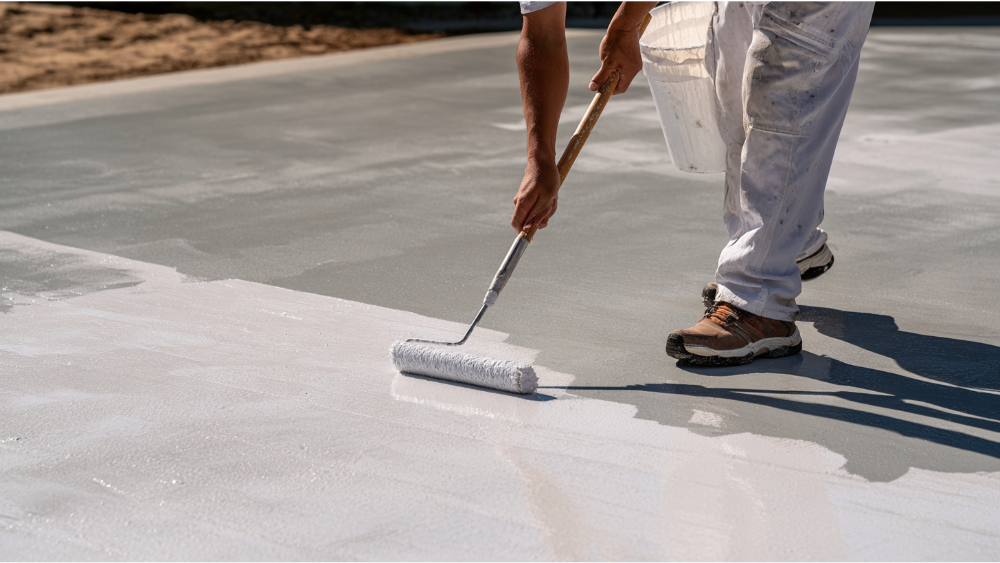
Temperature and weather windows can make or break the job. Watch surface temperature, not just air temperature, since a slab holds heat differently. A representative application range runs roughly 50 to 90°F, though ranges vary by product. You need a rain-and-dew-free window too: one asphalt coating requires a 48-hour rain-free forecast. High humidity slows curing and stretches drying time. Apply thin, even coats rather than one thick pass. If the product calls for you to mix two components, follow the ratio and pot life exactly, since an off mix can ruin cure. Some crews also broadcast fine sand into a wet coat for traction, which the data sheet will spell out. Cooler temperatures and higher humidity stretch every timeline, and the label controls the specifics.
How Many Coats Does a Driveway Need?
Two coats are typically recommended for an even, vibrant opaque finish. The first coat seals and anchors, the second builds color and evens out coverage. You can apply by roller or spray depending on the product and the size of the area. Allow roughly four to six hours of drying time between coats, though that shifts with product and weather. Use a roller rated for the coating, cut in the edges first, then roll the field in even passes over the entire driveway. Respect the recoat window on the label before you lay the second coat. Going too soon or waiting too long both cause adhesion problems between coats.
When Can You Walk or Drive on a Painted Driveway?
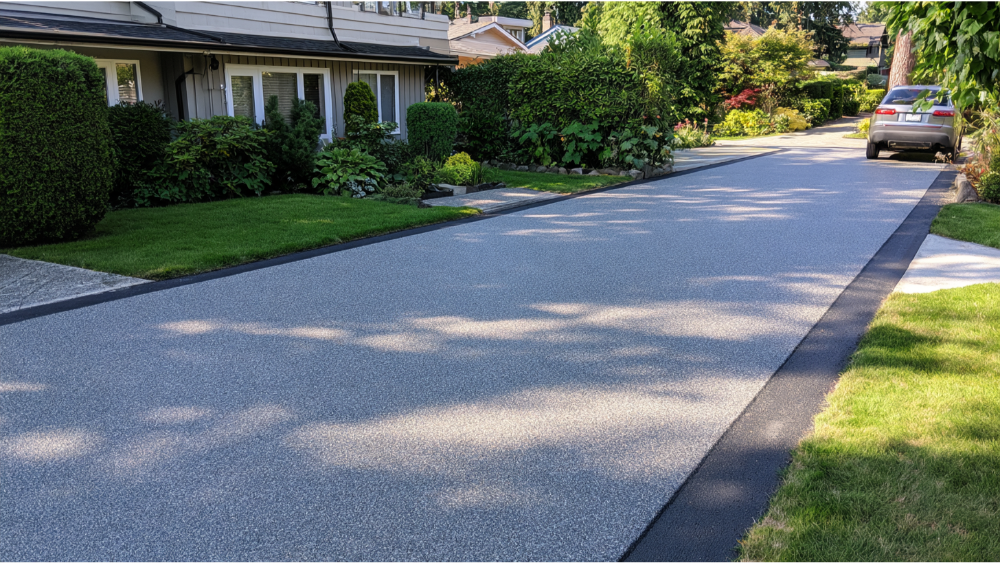
Never trust one universal drive-on time. The product's technical data sheet controls, and there are four different milestones: dry-to-touch, light foot traffic, full cure, and automotive return-to-service. The finish must be completely dry and cured before it meets vehicular traffic.
As an illustrative example, one residential concrete driveway coating specifies roughly 24 to 48 hours before light foot traffic, about 72 hours to full cure, 7 days before automotive tires, and 30 days before rinsing or cleaning, per its product data. An asphalt-specific acrylic coating reads differently: foot traffic after about 1 hour and car traffic after about 4 hours under its stated conditions. That same asphalt product notes newly paved asphalt should cure at least six months, or one full summer season, before coating. Cooler and more humid conditions extend all of these numbers.
Why Does Driveway Paint Peel? (And How to Prevent It)
When a driveway coating lifts, the cause usually traces to one of these:
- Trapped moisture pushing up through the slab
- A poor surface profile, so the coating never keyed in
- Oil contamination left under the coating
- Coating over an incompatible existing sealer
- The wrong coating type for the surface
- An application that's too thick
- UV exposure on a non-UV-rated product
- Driving on it before it fully cured
Hot tire pickup deserves its own explanation. People also call it hot tire pick up, or just hot tire pick. Heat, moisture, vehicle pressure, and tire compounds combine to soften or bond to a coating, then peel it up when the car pulls away. This hot tire effect is worst in high traffic areas like the main tire lanes near the house. Coatings formulated for horizontal vehicle surfaces are built to resist this. It's exactly why porch paint, standard exterior paint, and vertical masonry paint fail under tires.
Traction, Cleaning, and Keeping It Looking Good
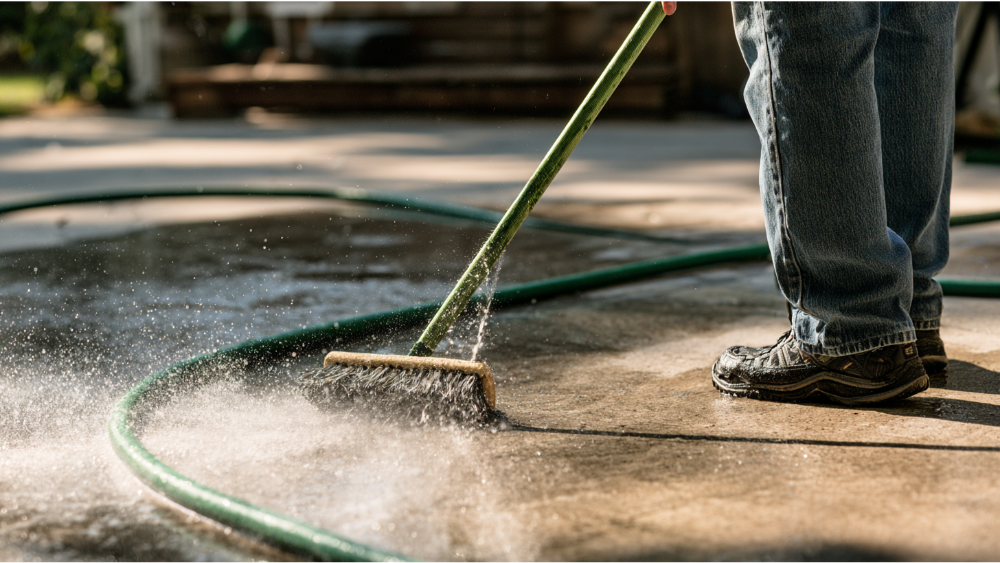
Painted surfaces can get slippery when wet, especially smooth or glossy ones. This matters most on pool decks, patios, and sloped walkways where people are on foot, and it applies to any stucco-walled patio surround for the same reason. Choose a coating meant for wet exterior walking surfaces, add a compatible anti-slip additive where it makes sense, and test the finished texture before you open it to traffic. The U.S. Access Board requires slip-resistant floor and ground surfaces but sets no single universal friction number, so don't assume any coating is automatically "ADA compliant."
For upkeep, clean gently so you don't abrade the finish prematurely, and rinse away road salt in winter so it doesn't sit and etch. UV-resistant products slow fading, and a lighter gray tone tends to hide tire marks better than a dark color. A clear coating over a tinted sealer can add protection while keeping the color underneath visible. Harsh chemicals can dull the finish, so keep cleaners mild. Expect occasional touch-ups in the tire lanes and reseal on schedule. Durability depends on how well the surface resists daily wear and tear. If emissions matter to you, low-VOC options (a representative spec is 100 g/L or lower) reduce them and can help on LEED projects.
How Long Does Driveway Paint Last?
There's no defensible universal lifespan, and anyone promising a fixed number is guessing. A well-chosen, well-prepped coating can last at least five years in normal climates, but that depends on surface condition, tire traffic, UV, moisture, climate, coating thickness, and the quality of the prep. Results vary based on all of those factors together. Even driveway-rated coatings may need annual touch-ups in the tire lanes. Regular maintenance, including a fresh sealer when the finish starts to thin, stretches the life considerably.
Should You DIY or Hire a Pro?
DIY can be reasonable on a small, sound, uncoated surface where you can follow the data sheet carefully. Professional evaluation makes more sense when you're dealing with unknown existing coatings, extensive repairs, moisture problems, mechanical profiling, or a large area like a long concrete driveway or a combined set of patios and walkways.
Handle waste responsibly either way. EPA guidance is clear that paint chips, grinding dust, stripper residue, and wash water should be contained and disposed of per local rules, never into storm drains or onto the ground, since storm systems often discharge untreated to local waterways. On pre-1978 properties, disturbing old painted surfaces beyond the roughly 20 square feet exterior minor-maintenance threshold can trigger lead-safe work rules, so confirm applicability before grinding or stripping unknown old coatings. Cover Pro Painting is EPA Lead-Safe (RRP) Certified, which matters on older properties where that work needs to be done correctly.
Frequently Asked Questions
What is the best paint for a driveway?
There's no single best paint. Use an exterior, vehicle-traffic-rated coating made specifically for your surface. For concrete, that's an exterior acrylic, an epoxy-modified acrylic, or a properly rated resin system that also works well on garage floors. Concrete paints built for this hold up far better than general-purpose paint. For asphalt, use an asphalt-specific coating. The same products that cover driveways often suit sidewalks and patios too.
Is painting a driveway a good idea?
It can be, when the surface is sound and you want a full, opaque color change. If you don't need solid color, a penetrating stain or sealer is often the lower-maintenance choice.
What type of paint do you use on a driveway?
Exterior acrylic or epoxy-modified acrylic concrete paints on concrete, or an asphalt-specific acrylic or seal coat on asphalt. Never indoor paint, standard wall paint, or unqualified porch paint, since none survive under tires.
Can I paint over a concrete driveway?
Yes, if it's clean, dry, structurally sound, properly profiled, free of incompatible old coatings, and (if new) fully cured. If any of that is off, repair and prep first.
Get a Straight Answer Before You Coat Your Driveway
Driveway paint is a coating system, and the honest recommendation is sometimes "not yet" or "stain instead." Before you commit, run this quick check:
Cover Pro Painting is a founder-led, full-service team handling interior and exterior painting, rot repair, siding, and carpentry, and we lead with surface prep and clear communication on every job. We're licensed, bonded, and insured in Washington State and EPA Lead-Safe Certified. Driveway coating isn't a confirmed primary service, so start with a free estimate and contact us to confirm service availability. Call 206-222-0435 and we'll give you a straight answer before anything goes on your driveway.
